PUBLISHED ON: August 19, 2025
By Web Desk
By Web Desk
Defining the “Government” and the “State”
In political theory, a government refers to the individuals and institutions temporarily tasked with administering a state’s affairs, managing laws, services, and foreign relations. A state, by contrast, is the enduring structure characterised by defined territory, permanent population, institutional integrity, a monopoly on legitimate force, and the capacity to provide public goods, regulate society, and uphold the rule of law. Sudan today lacks both: armed factions masquerade as governments, while the state’s core functions have imploded, resulting in a catastrophic “zero government, zero state” scenario.
Introduction: A Country Divided, a State Dismantled
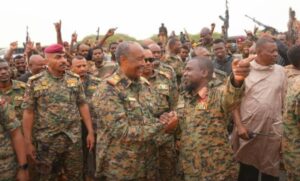
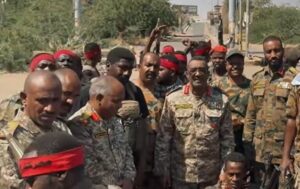
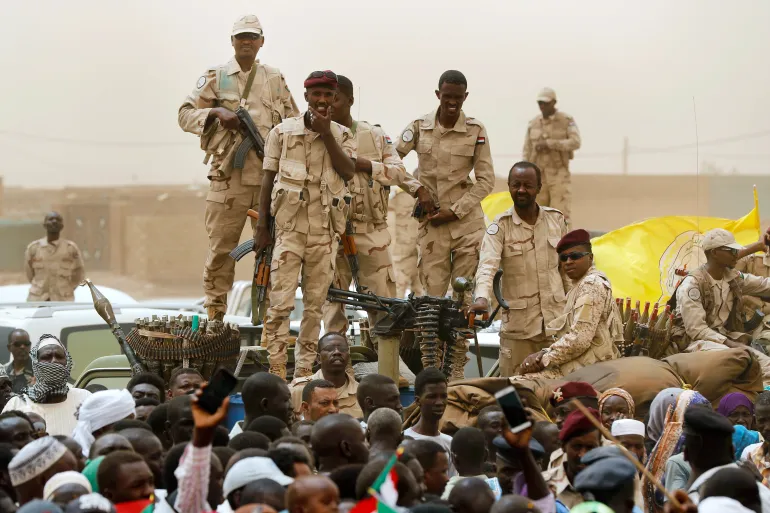
Sudan is now allegedly governed by two rival authorities, the Sudanese Armed Forces (SAF) in Port Sudan and the Rapid Support Forces (RSF) in Niyala, each claiming authority, albeit without legitimacy. Neither entity offers governance in the conventional sense; both subsist as war economies. The decline of the state apparatus, judicial independence, administrative coherence, and public services has left Sudan in a governance vacuum, with dire implications for regional and global stability, civilian welfare, and international response.
Zero Government: How Authority Has Fractured
a. Noxious Internal Contradictions
Sudan’s rival administrations in Port Sudan and Niyala lack the cohesion and institutional capacity to function as credible governments, as evidenced by their persistent internal contradictions. The Port Sudan coalition controls less than 45% of the country’s territory and commands an estimated 120,000–140,000 SAF personnel, yet is deeply divided between its military hierarchy, entrenched Islamist factions, dissatisfied mid-level officers, and opportunistic armed movements that shift allegiances for political or material gain. Key tribal and regional actors, including native administrations and the Sudan Shield Forces, oscillate in their loyalties, further destabilising the alliance.
In Niyala, the RSF-led coalition, estimated at 70,000–100,000 fighters, faces tribal fissures among Rizeigat sub-clans, ideological disputes with the SPLM-N (Hilu), and factionalism within allied political parties and armed movements, many of which control only pockets of territory in Darfur, Blue Nile, and the Nuba Mountains.
Both alliances are hampered by the absence of inclusive political frameworks, stable territorial control, and credible public service delivery, leaving Sudan with two nominal governments but no unified authority capable of meeting the core functions of governance.
Contradictory Legitimacies
The legitimacy claims of both the Sudanese Armed Forces (SAF) and the Rapid Support Forces (RSF) collapse under scrutiny. Each asserts a mantle of national guardianship, yet neither derives its authority from a popular mandate, constitutional continuity, or a transparent political process. The SAF presents itself as the protector of national sovereignty, while relying on transactional alliances with Egypt and tacit Saudi support.
The RSF frames its control as a stabilising force for marginalised regions, yet gold revenues sustain its authority channelled through UAE-linked networks and by coercive dominance on the ground.
Both operate under self-defined “emergency” mandates untethered to any legislative or judicial oversight, making their legitimacy performative rather than substantive. In practice, their political survival depends less on Sudanese consent than on the endurance of foreign sponsorship and military coercion, a contradiction that strips both of any claim to represent a sovereign state.
Institutional Meltdown
By the end of 2024, governmental functions had collapsed, and the Ministry of Finance was unable to issue a national budget or quarterly financial reports, resulting in a 80% decline in state revenues. State control over agriculture, education, and health systems dissolved into local warlord networks and humanitarian silos.
Infrastructure destruction, as electricity grids, water systems, roads, schools, hospitals, and state institutions have all collapsed, posing serious barriers to service delivery.
The collapse of Sudan’s governing capacity is further illustrated by the breakdown of its financial and regulatory institutions. The Central Bank of Sudan has effectively lost control over the national banking system, with commercial banks operating under fragmented rules or shutting down altogether in conflict-affected regions. Critically, the Bank has failed to enforce a uniform currency regime: two versions of the Sudanese pound now circulate simultaneously, as the old banknotes remain in use across much of the country, including in states nominally controlled by the Port Sudan government. This currency duality undermines monetary policy, fuels inflationary pressures, and facilitates illicit financial flows. The inability to recall or replace the old currency reflects a logistical collapse and eroded state authority, even in areas under supposed central control.
In RSF-administered zones, including Nyala, the situation is even more severe: fiscal operations are constrained by limited banking infrastructure, disrupted revenue collection, and a heavy reliance on cash economies that are vulnerable to counterfeiting and smuggling. These failures have accelerated capital flight, reduced public confidence, and entrenched the economic fragmentation of the state.
Economic Failure
The “governments” failed to meet basic state obligations: civil servants often go unpaid, hospitals shuttered, and schools remain closed. Inflation is further undermining governance capacity.
Currency Collapse: The Sudanese pound has lost over 350% of its value, fueling hyperinflation and public discontent.
Macroeconomic Decline: After two years of war, inflation exceeded 400%, unemployment had hit 45%, and public revenue had dropped by 75%. The tax effort (tax-to-GDP ratio) now stands at a mere 2%, down from only 5% before the war.
Conclusion: Governance in Name Only
Under the current duality of the Sudanese Armed Forces and the Rapid Support Forces, governance exists only as a façade. Neither side possesses the institutional integrity, national legitimacy, or administrative reach to fulfil the basic functions of government. The SAF’s fragmented coalition and reliance on foreign sponsorship mirror the RSF’s dependence on coercive control and illicit resource extraction, producing two rival authorities that govern no more than the territories they can physically hold, and even there without providing essential services. This fractured reality ensures that governance is reduced to a war economy logic, extractive, exclusionary, and fundamentally temporary.
Yet the consequences extend far beyond governmental paralysis. The failures of these two competing centres of power have eroded the pillars of Sudan’s statehood itself, its territorial cohesion, institutional capacity, and monopoly on legitimate force. This deeper dismantling of the state, with all its humanitarian, economic, and regional ramifications, forms the focus of the second part of this analysis.